

Poland RES Auctions 2026: What PV and Wind Investors Should Review Before Bidding
The Energy Regulatory Office (URE) has confirmed that the 2026 auctions for new onshore wind and PV installations will take place on 9 and 10 November, depending on project size.

The session on 9 November will be for new onshore wind and PV installations having an installed electrical capacity of 1 MW or less, while the session on 10 November will deal with new installations exceeding 1 MW.
In the seven auction sessions held between 2 and 10 November, URE says slightly more than 76 TWh of renewable electricity may be put up for sale, with a total value of around PLN 24.9 billion. The auctions for 2026 are to be reserved exclusively for new installations and will continue to be carried out on a price basis.
When people are getting ready for the Poland RES Auction 2026, their attention will certainly be directed towards bid pricing. However, the more important question should not simply be:
“What price will win?”
It is:
“What price can this project robustly support?”
An auction bid must not be looked at by itself since energy yield, grid availability, CAPEX and OPEX, permitting readiness and revenue downside all have a direct bearing on the economics that dictate how aggressively a project can bid without compromising its value or bankability.
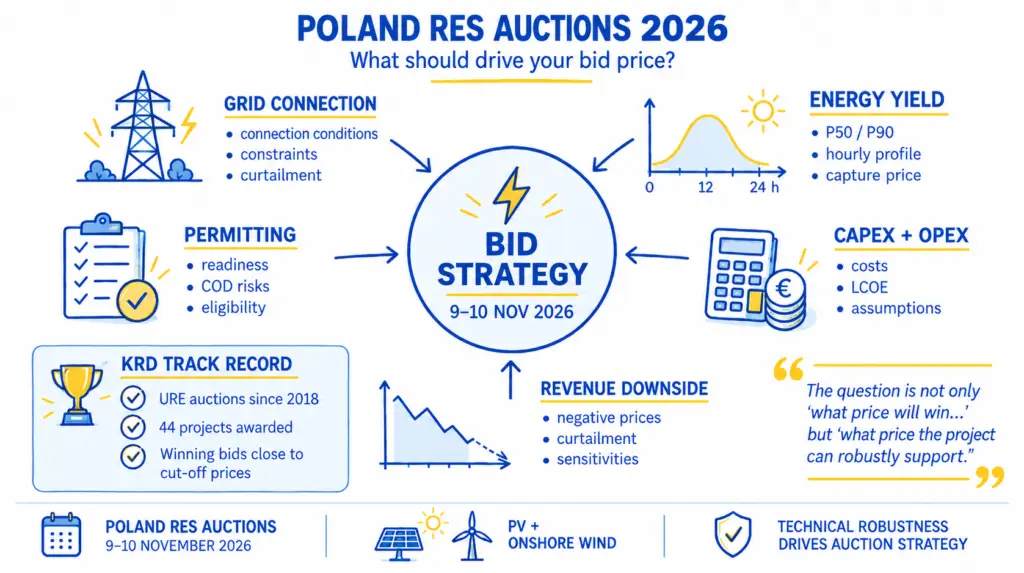
Grid connection should be one of the first areas reviewed before the 2026 URE renewable energy auction.
The fact that connection conditions have been established does not mean that grid risk has been eliminated. Investors and developers should understand the obligations set out in the connection conditions or agreement, the infrastructure and milestones needed, and whether the expected connection programme is still compatible with the planned COD.
Reduction in output, restrictions on exports, delays in the strengthening of the grid and other changes to the network can all cause the total amount of electricity that a project is eventually able to sell to decrease. It may therefore be assumed in the financial model that a certain level of generation and export will be achieved, even though this cannot always be accomplished in practice.
Before relying on grid assumptions to support a bid, they should be checked against the current project documentation and realistic operational scenarios.
Energy yield and generation profile
The energy output is also a basic factor that goes into both a Poland PV auction and a Poland onshore wind auction strategy.
The P50 and P90 estimates should be backed up by the relevant resource data, technical design, and loss assumptions. If the selected equipment or layout changes during development, or if assumptions for availability, degradation, or technical losses are revised, this will affect the expected production and must be taken into account in the model.
However, the annual generation is only part of the story.
The hourly generation profile can increasingly influence the revenue actually achieved by a renewable project. The timing of generation affects exposure to capture prices, negative-price periods and curtailment. Two projects with similar annual P50 generation may therefore have different revenue characteristics.
The assumptions used for the auction should reflect not simply how many MWh the project is expected to produce, but when those MWh are expected to be produced and how much of that generation can realistically be monetised.
CAPEX, OPEX and LCOE assumptions
The reliability of the cost assumptions also has an effect on a project’s bid strategy.
The CAPEX estimates should be brought into line with the existing design, the procurement strategy, the equipment specifications, the balance-of-plant scope and the grid works. Contingencies must remain suitable to the stage of development of the project rather than being reduced merely in order to make the investment case look more competitive.
The same thing can be said about OPEX: the assumptions regarding long-term maintenance, land costs, insurance, asset management and component replacement should be based on the specific project rather than on general benchmarks.
The reliability of LCOE when it is being used to make decisions depends on the underlying data. If an appealing LCOE is based on outdated CAPEX, optimistic availability, or an overestimated energy yield, it can lead to a false sense of confidence when determining the auction price.
Permitting and development status
Before the auction bid is finalised, it is necessary to identify any outstanding building permits, the environmental requirements, the land rights, the grid conditions and other development obligations together with their possible effects on schedule, costs and eligibility.
URE initially made clear that publication of the September schedule did not constitute the formal announcement of each auction. The seven auctions were subsequently formally announced on 22 September 2026. Developers do not need to wait for an auction announcement before starting the prequalification process, as documentation can be submitted at any time during the year.
URE states that it has 30 days from the date on which it receives a complete application to issue or refuse the certificate of admission. Applications submitted fewer than 14 days before the start of the relevant auction session will be left unexamined. Applications will also be left unexamined if they do not include the connection conditions or connection agreement, where applicable, or a final building permit where legally required.
For any projects which are aimed at 9 or 10 November, it is especially important to get early confirmation of the status of the documentation and permits.
Test the downside, not only the base case
An auction strategy should not be based solely on the base-case financial model.
Projects must be tested in the light of generation being lower than expected, greater curtailment, weaker capture prices, periods when prices are negative, increases in operating expenses, changes in construction costs, and delays to COD.
It is also important to consider combinations of risks; although a project might still be viable if there is a small reduction in generation or an increase in CAPEX on its own, the effect can be materially different if both occur at the same time as additional curtailment or weaker realised power prices.
It is therefore possible to use sensitivity analysis to assess how low an auction bid can be set while remaining supported by realistic project fundamentals, rather than relying on an optimistic base case.
KRD's experience in Poland's RES auction system
Since 2018, KRD has been supporting projects participating in Poland’s URE renewable energy auction system by carrying out technical project assessments, preparing projects for auction participation, reviewing financial assumptions, and supporting bid strategy.
That experience also involves the proprietary investments of KRD as well as projects carried out for international renewable energy developers, IPPs, and the major European utilities.
The records of KRD show that a solar pilot project at Wólka Przedmieście in 2018 was successfully awarded. In 2019, KRD assisted with Canadian Solar’s projects, namely Michałowo 1 and 2, each with a capacity of about 1 MW, and the bigger Gogolewo PV 2 project of 9.99 MW. All of these were successfully awarded, giving experience in both the sub-1 MW and the greater-than-1 MW auction categories.
In northern Poland, KRD supported the EOS 2 and EOS 3 PV projects, both of which were submitted to the AZ/8/2020 auction at a bid price of PLN 259.99/MWh and were successfully awarded, according to KRD’s project documentation.
A very important example occurred at the June 2021 auction round when KRD evaluated a portfolio of up to 49 sub-1 MW PV projects for a major European utility, about 35 of which were eventually submitted, and all of the submitted projects were awarded.
The records kept by KRD indicate that the successful bids were usually set at a level only between PLN 1 and 2 per MWh below the final auction cut-off. The aim was not merely to bid low enough to win, but to position the bids as high as reasonably possible while remaining competitive, with the projects’ technical and financial fundamentals used to assess how far the bids could safely be reduced.
In 2025, the same method was followed. Three photovoltaic projects supported for a European IPP were successfully awarded at rates of PLN 328/MWh, PLN 358/MWh and PLN 365/MWh respectively, again achieving prices close to the upper end of the relevant winning ranges.
This experience underlines a key aspect of the 2026 auctions: it is not enough simply to win the auction; the bid must also be set at a level that preserves the underlying project’s economic viability and financeability.
From auction price to technically defensible strategy
As the November auctions approach, developers and investors will naturally consider how competitive their projects can be.
What does the most recent assessment of energy output indicate? To what extent is the generation vulnerable to the effects of curtailment or capture price changes? Are the assumptions regarding capital expenditure and operating expenditure up to date? Is the project truly ready from both a permitting and grid connection point of view? How resilient are the projected returns if the base case is not achieved?
Only after those questions have been addressed can the bid price be considered in the appropriate context.
Since it has experience in URE auctions going back to 2018, KRD Renewables brings together practical knowledge of auctions with independent technical due diligence in the field of renewable energy in Poland. The company provides support to investors, developers and lenders in connection with solar PV and onshore wind projects by examining the technical assumptions that underlie the project’s economics and by spotting the risks that may affect its value, bankability and auction strategy.
For investors in Poland seeking an independent technical advisor, the objective should go beyond simply identifying a price that wins the auction. It should be about determining a bid price that is competitive while remaining supported by robust technical and financial assumptions.
Review Your Project Before Bidding
Explore KRD’s Solar PV technical advisory and Wind technical advisory, or our support for investors and lenders. Discuss your project’s yield, grid and technical assumptions with our team.


